Pinco Indir’ni Kəşf Etmək: Bu Gün Onlayn Alış-Veriş Üçün Bələdçi
Onlayn alış-veriş dünyası, müasir istehlakçıların xidmətinə yeni imkanlar təqdim edir. Bu məqalə, “Pinco Indir” platformasını kəşf etməyə və bu platformada alış-veriş etməyin yollarını aydınlaşdırmağa yönəldilmişdir. Pinco Indir, müasir onlayn alış-veriş sistemlərinin bir nümunəsidir; burada müştərilər ən yaxşı qiymətləri və keyfiyyətli məhsulları tapa bilərlər. Bu bələdçi, sizə Pinco Indir-dən necə səmərəli istifadə edəcəyiniz və alış-verişinizin necə daha rahat olacağı barədə məlumat verəcək. Gəlin, Pinco Indir-in nə olduğunu, onun üstünlüklərini və satın alma prosesini dərindən incələyək.
Pinco Indir Nədir?
Pinco Indir, müştərilərə geniş çeşiddə məhsullar təklif edən onlayn alış-veriş platformasıdır. Bu platforma, istifadəçilərin fərqli kateqoriyalarda məhsulları asanlıqla axtarıb seçməsinə imkan yaradır. İstifadəçilərin rahatlığı üçün Pinco Indir, müasir dizayn və intuitiv interfeys ilə təmin olunmuşdur. Aşağıda Pinco Indir-in bəzi əsas xüsusiyyətlərini təqdim edirik:
İstifadəçi dostu interfeys
Müxtəlif məhsul kateqoriyaları
Aksiyaların və endirimlərin geniş spektri
Təhlükəsiz ödəmə sistemləri
Yüksək müştəri xidməti
Pinco Indir-də Alış-Veriş Üstünlükləri
Pinco Indir-də alış-veriş etmək, müştərilər üçün bir çox üstünlüklər təqdim edir. Bu platformada alış-veriş etməyin bəzi əsas üstünlüklərini aşağıda sadalayırıq:
Rahathlıq: Evinizdən çıxmadan alış-veriş etmək imkanı.
Çeşid: Rəqiblərinə nisbətən daha geniş məhsul çeşidi.
Qiymət dəyişikliyi: Düşük qiymətlər və müntəzəm endirimlər.
İcra sürəti: Sifarişlərin tez icrası.
Müştəri məsləhətləri: Başqalarının rəylərinə baxaraq doğru seçim etmək imkanı.
Alış-Veriş Prosesinin Addımları
Pinco Indir platformasında alış-veriş prosesi olduqca sadədir. Aşağıda bu prosesi addım-addım açıqlayırıq:
Qeydiyyat: Platformada qeydiyyatdan keçərək öz hesabınızı yaradın.
Məhsul axtarışı: Axtardığınız məhsulları müvafiq kateqoriyalardan seçin.
Seçim: Maraqlı məhsulunuzu seçin və “səbətə əlavə et” düyməsini basın.
Ödəniş: Səbətinizə daxil olun və ödəniş prosesinə başlayın.
Çatdırılma: Məhsulunuzun çatdırılma ünvanını daxil edin və sifarişinizi təsdiq edin.
Pinco Indir-i Niyə Seçməlisiniz?
Pinco Indir, onlayn alış-veriş mühitində özünəməxsus yerə malikdir. Bu platforma, istifadəçilərə məhsul seçimini asanlaşdıran və alış-verişi daha cəlbedici edən bir çox funksiyalar təqdim edir. Üstəlik, müştəri məmnuniyyətini ön planda tutmağı ilə tanınır. İstifadəçilər, burada alış-veriş edərkən mükəmməl alış-veriş təcrübəsi yaşaya bilərlər. Eyni zamanda, fərqli fərdi təcrübələri ilə daha çox müştərini cəlb etməkdədir. Məsələn, müştərilər, alış-veriş etməzdən əvvəl məhsul haqqında icmalları oxuyaraq daha məlumatlı seçkilər edə bilərlər. Bununla yanaşı, Pinco Indir istifadəçilərin 24/7 müştəri dəstəyi ilə sorğularına cavab verməyə hazırdır Pinco.
Nəticə
Pinco Indir, müasir onlayn alış-veriş dünyasında diqqətə layiq platformalardan biridir. Bu bələdçi vasitəsilə, siz Pinco Indir-in nə təklif etdiyini, onun üstünlüklərini və alış-veriş prosesini dərindən öyrənmiş oldunuz. Aktuallığı, istifadəçi dostu interfeysi, geniş məhsul çeşidi və müştəri xidmətləri ilə, Pinco Indir bu günkü alış-veriş mühitində seçilməyə dəyər. Onlayn alış-verişdən maksimum fayda əldə etmək üçün Pinco Indir-i sınamağı unutmayın.
Tez-tez Verilən Suallar (FAQ)
1. Pinco Indir-də qeydiyyatdan necə keçə bilərəm?
Pinco Indir-də qeydiyyatdan keçmək üçün, platformanın veb saytına daxil olun və “Qeydiyyat” bölməsini seçin. Lazım olan məlumatları düzgün daxil etdikdən sonra hesabınızı təsdiqləyin.
2. Hər hansı bir məhsulu qaytarmaq mümkündürmü?
Bəli, Pinco Indir, müştərilərin beğənmədiyi məhsulları qaytarmaq hüququnu tanıyır. Qaytarma qaydaları üzrə daha ətraflı məlumatı veb saytdan əldə edə bilərsiniz.
3. Pinco Indir-də ödəmə metodları hansılardır?
Pinco Indir-də, kredit kartları, bank köçürmələri və digər elektron ödəmə sistemləri kimi bir çox ödəmə metodları mövcuddur. İstədiyiniz metodla asanlıqla ödəniş edə bilərsiniz.
4. Məhsul çatdırılması nə qədər vaxt alır?
Məhsul çatdırılması, seçdiyiniz çatdırılma metoduna görə dəyişir. Adətən, 1-3 iş günü ərzində məhsulunuzu ala bilərsiniz.
5. Nəzərdə tutduğunuz endirimlər harada mövcuddur?
Pinco Indir-in müntəzəm olaraq təqdim etdiyi endirimlər və kampaniyaları “Aksiyalar” bölməsində tapa bilərsiniz. Burada fərqli məhsul kateqoriyalarında endirimləri izləyə bilərsiniz.
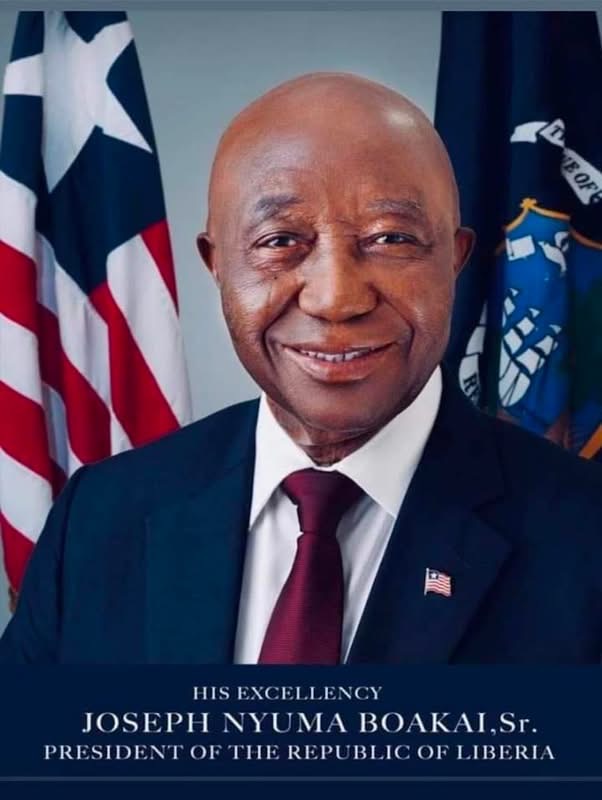
Since the death of President William Richard Tolbert, Jr., and the inception of indigenous Liberian presidents, President Joseph Nyuma Boikai is the most educated and experienced statesman to enter the Executive Mansion. He is also the eldest of the other two indigenous presidents, Samuel Kanyon Doe, and George Manning Weah.
President Boikai Is the Bridge between True Whig & Indigenous Rulership
President Boikai is the bridge between the True Whig and Indigenous rulership. He possesses the wisdom and stagecraft to restore the statecraft the True Whig regime possessed and that the new cadre of indigenous leaders before him lacked. Hence, traditionally speaking, it is safe to say that President Boikai is the Old Mat we must sit on to weave a new National Mat.
President Boikai possesses wisdom; he is humble and he acknowledges the contributions of patriotic citizens as President Tolbert did. He also speaks “good English” says U.S. President Donald Trump, and he represents Liberia diplomatically at international fora. All of these qualities are worth emulating and we must not take them for granted because they help to reconstruct a wholesome functioning society if we all provide positive support towards the realization of national peace and unity.
Therefore, we must not allow detractors to distract us from the path of peace and reconciliation to return to war, violence and lawlessness, just to please the egos of a handful of self-centered politicians who do not have the interest of the masses at heart. Nonetheless, the process of national transformation, and promotion of national unity, peace reconciliation, and rule of law, cannot be continually attained with a weak information, cultural, touristic and communications strategy.
Weak Information, Broadcasting System and Cultural/Touristic System
The Information Ministry and the Liberia Broadcasting System, as well as the culture and tourism wings of government must perform 100 % better in order to adequately inform the Liberian populace about GOL domestic and foreign policies. They must be rapid, expedient, and fair in disseminating information to the citizens so that Liberians do not rely on private communication networks to feed them with misinformation that are geared towards keeping Liberia in a chaotic and lawless state.
Additionally, the heads of these strategic public relations institutions must be open-minded, friendly and willing to embrace well-meaning Liberians who have creative talents to enhance and disseminate GOL’s domestic and foreign policies in multifaceted forms, through music, dance, theatre, literacy, community engagement events, etc.
In other words, the Ministry of Information, Liberia Broadcasting System, and Culture and Tourism are supposed to be the “PUBLIC RELATIONS” wing of the government of Liberia, but in my opinion and based on my interaction with heads of these government institutions, they have a very poor public relations rating. Therefore, there is a dire need for President Boikai to move swiftly in addressing this matter before Liberians become overdosed with misinformation which may lead to loss of confidence in his administration and the loss of the developmental gains that have been made thus far.
For instance, a “weekly Information Press Conference” will not cut it. An LBS that is unwelcoming and unfriendly towards creative Liberian content creators just for the sake of personal job protection will not cut it. And the dormancy of these two strategic government information and communications agencies means there will be continual widespread of misinformation, chaos, and a direct sabotage of all the good efforts the Boikai administration is undertaking to implement major reforms and national development.
Difference between Past and Present Information, Culture, Tourism and LBS Gatekeepers
During my days at the University of Liberia when I newly established Dehkontee Artists nearly fifty years ago, the Ministers of Information Johnny McClain, Dr. Edward Kesselly, and J. Jenkins Peal, and Deputy Minister for Culture, Bai T. Moore (my father and mentor) were very friendly, respectful, and motivational. They went scouting for young Liberian talents to help them promote GOL domestic and foreign policies and to empower the youth and ordinary Liberians to have a voice in national development.
I was one of those employed by Johnny McClain as a cadet at MICAT. Dr. Edward Kesselly, J. Jenkins Peal, Bai T. Moore attended DATI performances, and they created a line of communications between the President’s office and DATI. All attempts to establish rapport with the current Minister of Information is completely zero. We have a “I will call you back” relationship. Maybe I may receive a call for solid discussion on how the Minister of Information can collaborate with Dehkontee Artists Theatre after President Boikai leaves office or after President Boikai appoints a new Information Minister.
At LBS T. Kla-Williams, Director-General of LBS, Eustace Smith, Omodele Bright-Greaves, Wilmot Stubblefield, Martin Brown, warmly welcomed and collaborated with local artist groups, National Cultural Troupe, Dehkontee Artists Theatre, Trotro Artists, Cultural Ambassadors, Womtee Theatre, E. J. Roye Drama Group, Malawala Balawala, University of Liberia Players, Cuttington University and University of Liberia Choruses, etc.
We ran television and radio drama series. We worked as one family of creative individuals who promoted the image of Liberia to the outside world. Today, what LBS does with its airtime and what their relationship is with Liberian artists in terms of providing airtime to promote Liberian culture and history remains a mystery to me.
The Ministry of Foreign Affairs also played a significant role in uplifting my work on the international scene.
On July 26, 1978, Ambassador Joseph Morris, then Liberia’s Ambassador accredited near Freetown, Sierra Leone, had the opportunity to watch “The Chains of Apartheid” at the State House in Freetown. As a representative of Liberia, he immediately sent a telegram to President Tolbert, urging the President to watch DATI’s performance of his foreign policy on the Liberation of Southern Africa on stage. Within weeks, Speedy invited DATI to the Executive Mansion to perform for him. Speedy did not stop there, he invited DATI to perform when Ghanaian Head of State Fred Akkuffo and Jerry Rawlings visited Liberia in 1979.
Minister of Foreign Affairs, Honorable C. Cecil Dennis, Jr., one of Liberia’s most erudite diplomats, sponsored a performance of Dehkontee Artists Theatre at the Monrovia City Hall Auditorium for all diplomats accredited near Monrovia in 1979.
Mind you. I was not a member of the True Whig Party Youth Wing, and I am not Congau or Americo-Liberian. I was just an ordinary and creative Liberian youth and “Country Boy” that had something tangible to offer my country and patriotic Liberian government officials responded favorably based on my talents.
Government Officials Must Be Loyal to the President and Government in Which They Work
Government officials must be loyal to the President and government they are appointed to serve. The difference between the government officials of the old regime and the ones we have today is as vast as the difference between day and night. Back in the day, we could dialogue with our government officials and get things done but now, one can hardly get a phone call returned or answered. Back in the day, government officials were very loyal to the President who appointed them to office.
Rather, they did everything within their power for their administration to succeed. I pray that Boikai’s appointed officials will be more cordial and receptive of the contributions of patriotic citizens who want to help develop their country, instead of driving away or discouraging productive citizens to assist government in enhancing good governance in Liberia.
I recall having a virtual meeting with the Director-General of the National Tourism Agency when she cut me off in the middle of my recommendation to explore ways in which DATI can assist the government of Liberia to provide effective cultural and touristic programs in Liberia. “We are doing everything you are talking about” and that was the end of the conversation. We cannot continue to put people in positions of public trust who are not willing to collaborate and/or who feel the government entities they run are their private properties. That is undemocratic. We must learn to sit on the Old Mat to weave a New Mat.
Rabbi Prince Joseph Tomoonh-Garlodeyh Gbaba, Sr., Ed. D. September 6, 2026
Whales are among the largest and most remarkable animals on Earth. These marine mammals live in oceans around the world, from warm tropical waters to the cold seas surrounding the poles.
Life Beneath the Surface
Although whales spend their lives in water, they breathe air through blowholes located on top of their heads. They must regularly return to the surface to breathe before diving again in search of food or traveling through the ocean.
Whales are warm-blooded, give birth to live young, and nurse their calves with milk. A thick layer of fat called blubber helps protect them from cold water and stores energy during long migrations.
Two Main Groups
Whales are generally divided into baleen whales and toothed whales. Baleen whales filter small animals from the water using flexible plates inside their mouths. This group includes blue whales, humpback whales, and gray whales.
Toothed whales use teeth to catch fish, squid, and other prey. Many of them also use echolocation, producing sounds and listening for returning echoes to understand their surroundings. Sperm whales, belugas, and orcas belong to this group.
The Blue Whale
The blue whale is the largest known animal to have ever lived. An adult can grow longer than a city bus and weigh well over one hundred tonnes. Despite its enormous size, it feeds mainly on tiny crustaceans called krill.
Communication and Migration
Whales communicate using clicks, whistles, pulses, and complex songs. Some sounds can travel across great distances underwater. Humpback whales are especially famous for their long, patterned songs.
Many species migrate thousands of kilometres each year. They often feed in cold, nutrient-rich waters before traveling to warmer regions where they mate and give birth.
Protecting Whales
Commercial hunting once caused severe declines in many whale populations. Today, whales also face threats from fishing gear, ship collisions, underwater noise, pollution, and changes to ocean ecosystems.
Conservation programs, safer fishing practices, protected habitats, and international cooperation can help whale populations recover. Protecting whales also supports healthier oceans because these animals play an important role in marine food webs and nutrient cycles.
“We cannot simply copy and paste what took place in Rwanda or South Africa. We must learn from them and adapt what is relevant to Liberia’s unique history and culture”.
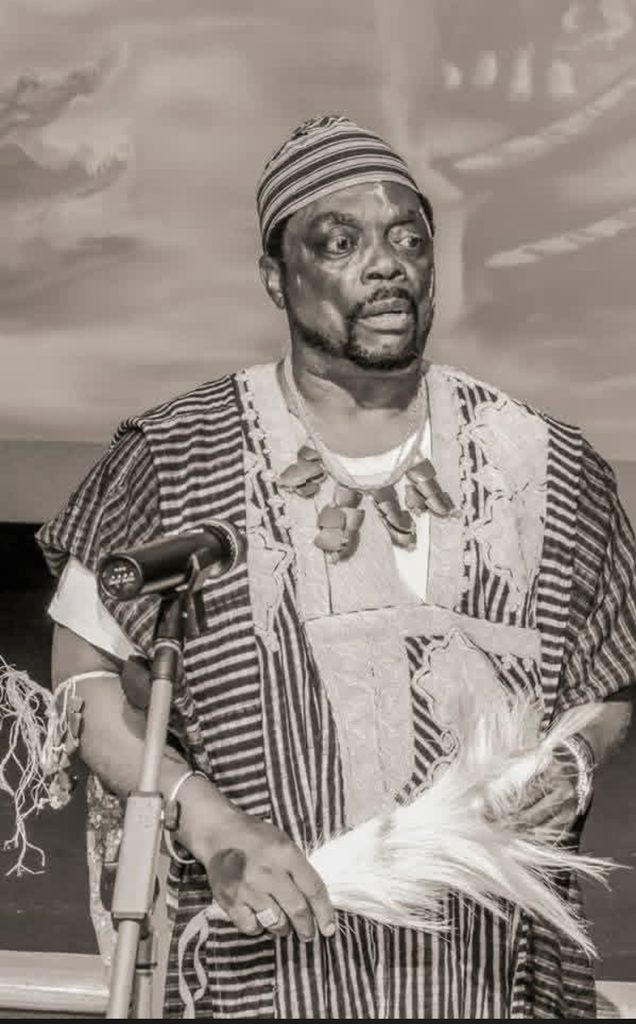
MONROVIA, LIBERIA — August 31, 2026: Liberian playwright, educator, cultural advocate and peacebuilding expert Dr. Rabbi Prince Joseph Tomoonh-Garlodeyh Gbaba, Sr., Ed.D., has called on President Joseph Nyuma Boakai, Sr. to ensure that Liberia’s renewed peacebuilding and cultural revival efforts are inclusive, participatory and rooted in Liberia’s own history and traditions.
Dr. Gbaba made the call in a communication to President Boakai following reports that a Liberian delegation is visiting Rwanda and South Africa to study their approaches to peace, reconciliation and cultural preservation. While welcoming the President’s initiative, Dr. Gbaba said Liberia can learn valuable lessons from both countries but should not simply “copy and paste” foreign models into the Liberian context.
He argued that Liberia must first engage victims and survivors of the civil conflict, traditional leaders, elders, young people, historians, cultural practitioners and professionals in areas including culture, education, anthropology, law and peacebuilding.
Calls for Internal Consultation
Dr. Gbaba said a genuine national peace-building process should begin with an assessment of Liberia’s own history and traditional conflict-resolution practices. He stressed that Liberia’s diverse cultural and ethnic communities must have a meaningful voice in the reconciliation process, adding that solutions developed for Rwanda or South Africa may not necessarily address Liberia’s unique historical and cultural circumstances.
The cultural advocate also disclosed that Dehkontee Artists Theatre, Inc. (DATI) previously submitted a proposal to President Boakai offering its expertise in culture, education, peace-building and national unity. According to Dr. Gbaba, the proposal outlines ways DATI can assist the government in strengthening Liberia’s peace-building process and promoting a cultural renaissance.
He therefore urged the administration to consult qualified Liberian professionals and organizations with decades of experience before finalizing its national cultural and reconciliation framework.
“Learn From Others, But Build a Liberian Solution”
Dr. Gbaba emphasized that international experiences should serve as lessons rather than templates. He encouraged President Boakai to ensure that future committees and national delegations reflect Liberia’s diversity, history, professional expertise and generational perspectives.
Despite his concerns, Dr. Gbaba described the President’s peace-building initiative as an important opportunity to address Liberia’s cultural and reconciliation challenges. He reaffirmed his willingness, through DATI, to work with the government and other stakeholders to promote peace, national unity, cultural preservation, reconciliation and youth development.
“We cannot simply copy and paste what took place in Rwanda or South Africa. We must learn from them and adapt what is relevant to Liberia’s unique history and culture,” Dr. Gbaba maintained.
One of Dr. Gbaba profound memories from working as Principal of Zwedru Multilateral High School (ZMHS) in Grand Gedeh County was the formation of the ZMHS Cultural Troupe and the production of “Yah” (“Vision”). My vision in 1988 was to raise funds and to elevate the institution from a technical/vocational high school to a technical and vocational college.
In addition, his aim was to provide a wholistic and culturally relevant education for children in the hinterland of Liberia so that they may appreciate their cultural heritage and be on par with their colleagues around the country. Another reason was to showcase the talents of Liberian youth from the hinterland and promote the Grand Gedeh educational system nationally and internationally.
The ZMHS Cultural Troupe included prominent traditional Krahn artists and musicians the likes of Bai-Beh, Gayeah-Ninneh Gaye, Gayeebah-Paboo, and two prominent Krahn dance masks–“Zahjay Gleh” from Tchien Zonnie and “Voorpen” from Gorhbo-Francee. Altogether, the ZMHS Cultural Troupe consisted of one hundred performers of students and traditional artists combined.
About the Play
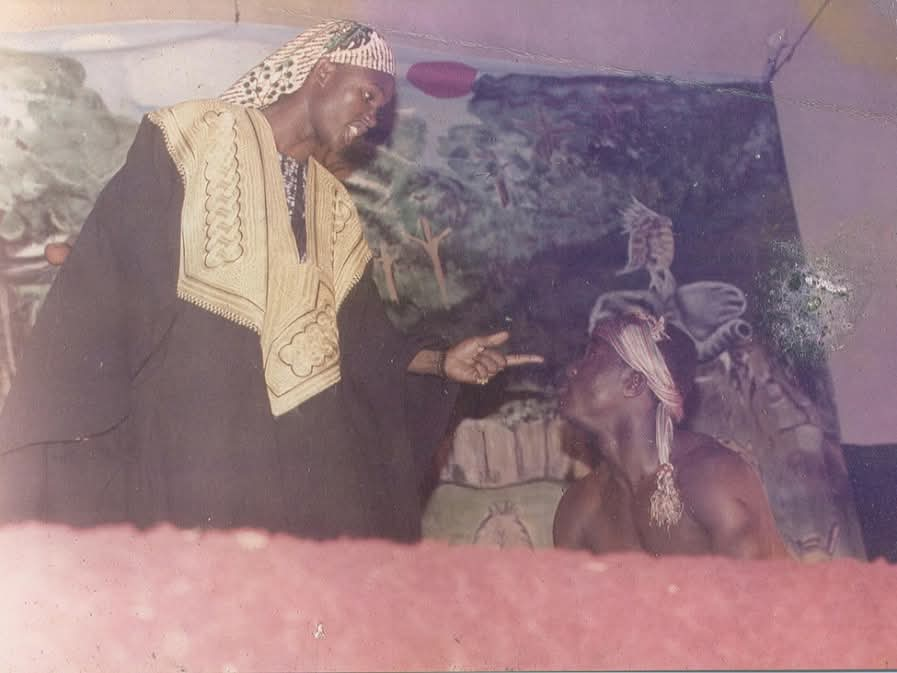
The word “Yah” in the Krahn language means, “vision”. It was a play he wrote, directed and produced to share a vision he had in which the status quo collapsed because they did not abide by the precepts of our ancestors.
The ZMHS Cultural Troupe travelled to Monrovia and stationed at the Chief Compound on Macdonald Street and Camp Johnson Road for two weeks. The play was performed at the Relda Theatre in Monrovia for two nights before a packed audience in 1988. Every evening, Liberians, especially members of the Krahn ethnic group of Liberia, gathered at the Chief Compound to be entertained by the traditional musicians and the dance masks.
Prominent Grand Gedeheans who supported this effort included T. Shad Garlo, General Alfred Manyeah, and Governor of the National Bank of Liberia, Thomas Voor Hanson, and Representative William Glay. President Samuel Kanyon Doe and many prominent Grand Gedeheans in government did not attend any of the performances.
Rabbi Prince Joseph Tomoonh-Garlodeyh Gbaba, Sr., Ed. D. August 10, 2026
MONROVIA, LIBERIA — August 17, 2026: Liberian cultural icon, playwright, educator and peace advocate Dr. Rabbi Prince Joseph Tomoonh-Garlodeyh Gbaba, Sr. has expressed appreciation to young Liberians and youth organizations for publicly supporting President Joseph Nyuma Boakai, Sr. for honoring him with Liberia’s Distinction in the Order of the Star of Africa with the Grade of Commander.
In a message directed to the youth, Dr. Gbaba thanked what he described as Liberia’s “progressive youths” for recognizing his more than 52 years of work aimed at preserving Liberia’s shared cultural heritage, promoting national unity and connecting younger generations with the traditions and values of their ancestors. He said his lifelong mission has been to ensure that Liberian youth understand and appreciate their ancestry, history and cultural traditions as essential foundations for building a peaceful and prosperous nation.
A Call for Youth Opportunities and Cultural Inclusion
Dr. Gbaba also raised concerns about what he described as barriers preventing qualified Liberians and youth leaders from contributing to national development. He said he has made efforts over the years to create opportunities for young Liberians through his areas of expertise, particularly culture, education, theatre and peace-building, but believes some proposals have not received the necessary attention from policymakers.
According to him, one of his major concerns is a strategic proposal submitted through Dehkontee Artists Theatre, Inc. (DATI) that seeks to create employment and training opportunities for Liberian youth while contributing to Liberia’s post-war peace-building and reconciliation process.He expressed hope that President Boakai will give favorable consideration to the proposal and provide an opportunity for its implementation.
Liberian Solutions to Liberian Challenges
Dr. Gbaba also called for greater participation of Liberian cultural and peace-building experts in national efforts to address the country’s social and cultural challenges. He specifically expressed concern over reported plans to establish a national cultural committee and the possibility of seeking lessons from countries such as South Africa and Rwanda without sufficient consultation with Liberian experts.
While acknowledging the value of international experience, Dr. Gbaba argued that Liberia’s challenges must also be addressed through its own history, languages, traditions and indigenous conflict-resolution practices. He emphasized that Liberia’s diverse ethnic communities have their own cultural systems and traditions that should be considered when developing national peace-building and reconciliation strategies.
“The resolution of a Rwandan conflict is not identical to the resolution of a Liberian conflict,” Dr. Gbaba maintained, stressing the importance of culturally relevant approaches to peace-building. He further argued that language and cultural understanding are essential when mediating conflicts involving Liberia’s various ethnic communities.
A Message to Liberia’s Youth
Dr. Gbaba urged young Liberians to remain committed to peace, national unity, cultural pride, justice and national development.He expressed appreciation to youth representatives from Maryland, Grand Kru, Margibi and River Gee Counties, as well as members of DATI chapters in Montserrado, Maryland, River Gee and Margibi, for standing with his vision.
He said their support demonstrates that Liberia’s young people remain interested in building a better future and preserving the country’s cultural identity concluded by expressing hope that President Boakai will support initiatives designed to provide jobs, skills training and development opportunities for Liberian youth, while strengthening national peace-building and reconciliation.
“My beloved children, thank you for standing with me and for recognizing the importance of the work we have undertaken for more than five decades. I pray that President Boakai will favor our proposal to create jobs and training opportunities for Liberian youths.”
Dr. Rabbi Prince Joseph Tomoonh-Garlodeyh Gbaba, Sr., Ed.D.
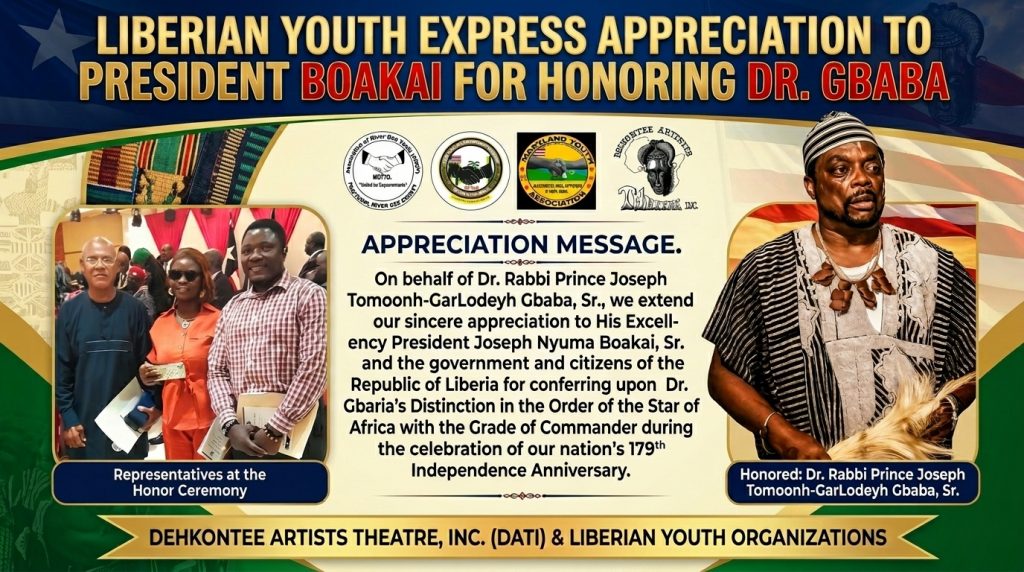
Representatives; left to right ( Statesman Meshach Sieh Elliott, Stateswoman Hawa Gowah and Mr. Rameses A. Porte, Jr)
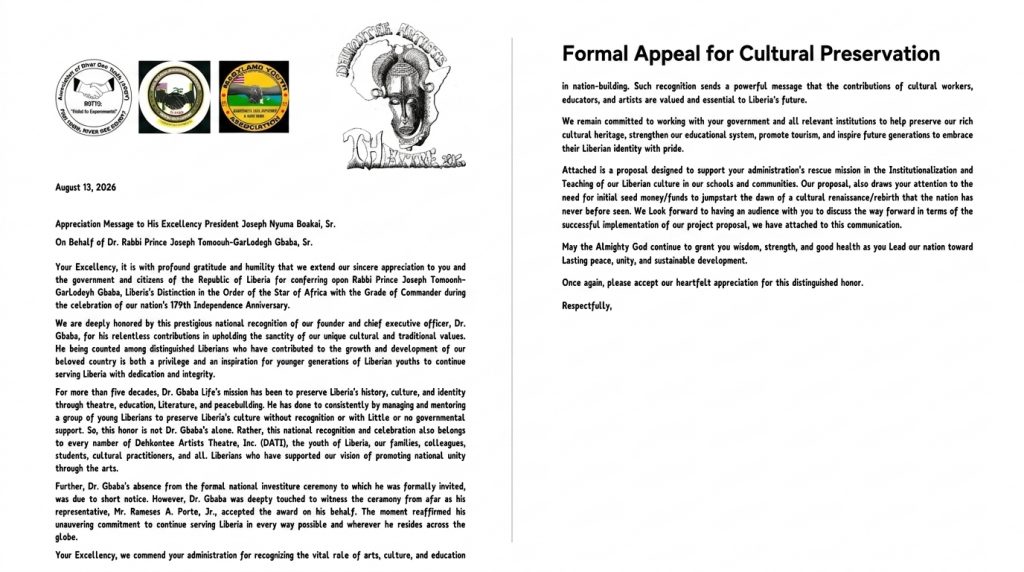
MONROVIA, LIBERIA — August 15, 2026: Youth organizations and young people from across Liberia have expressed appreciation to President Joseph Nyuma Boakai, Sr., and the Government of Liberia for conferring Liberia’s Distinction in the Order of the Star of Africa with the Grade of Commander on renowned cultural icon, educator, playwright and peace advocate Dr. Rabbi Prince Joseph Tomoonh-Garlodeyh Gbaba, Sr.
In a letter of appreciation, the youth described the recognition as a well-deserved honor for Dr. Gbaba’s more than five decades of service to Liberia through theatre, education, cultural preservation, peace-building and the promotion of national unity. The youth groups said the recognition should inspire a new generation of Liberians to embrace their culture, develop their talents and contribute meaningfully to national development.
They also welcomed Dr. Gbaba and Dehkontee Artists Theatre, Inc. (DATI)’s continued interest in working with the Government of Liberia on initiatives focused on national unity, cultural preservation, education, tourism and youth development. The letter concluded with a call for greater collaboration among the Government of Liberia, youth organizations and cultural institutions to preserve Liberia’s identity and build a more united nation.
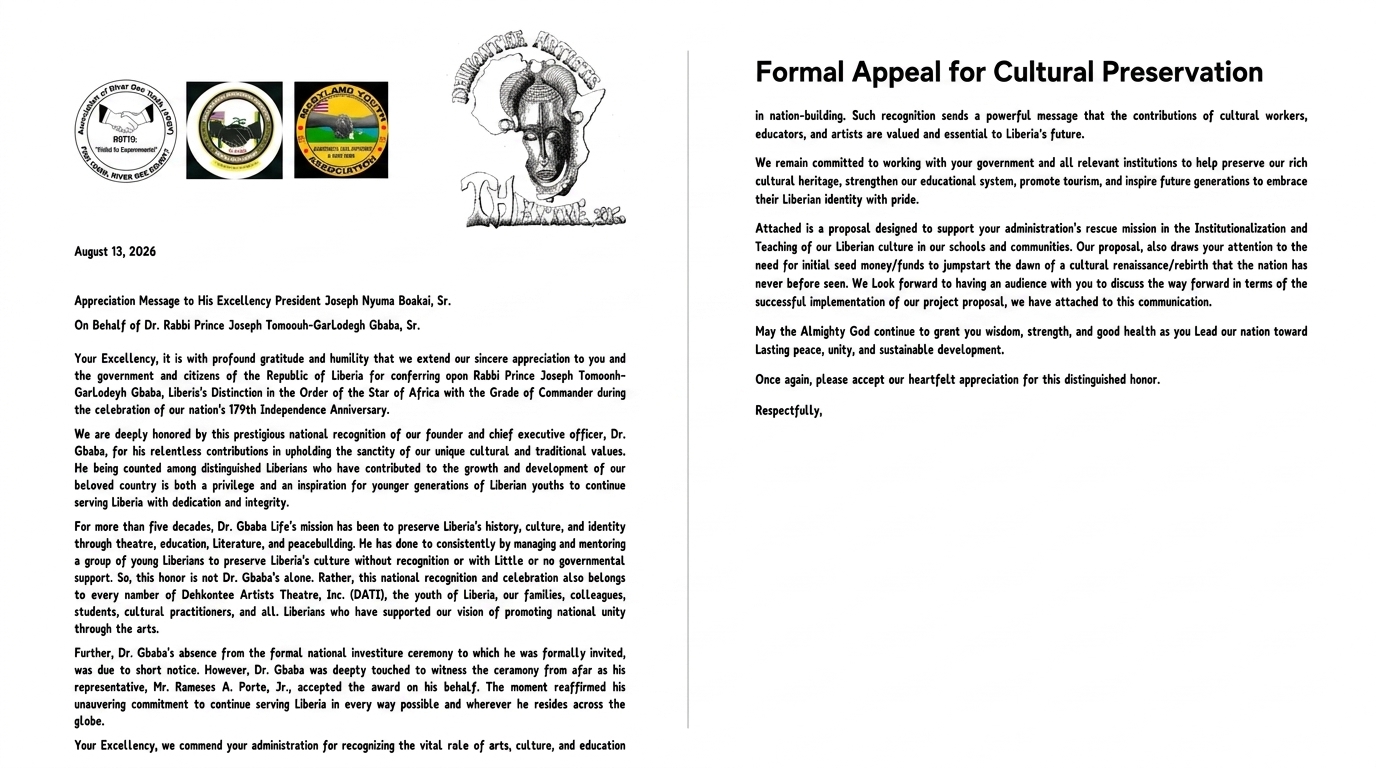
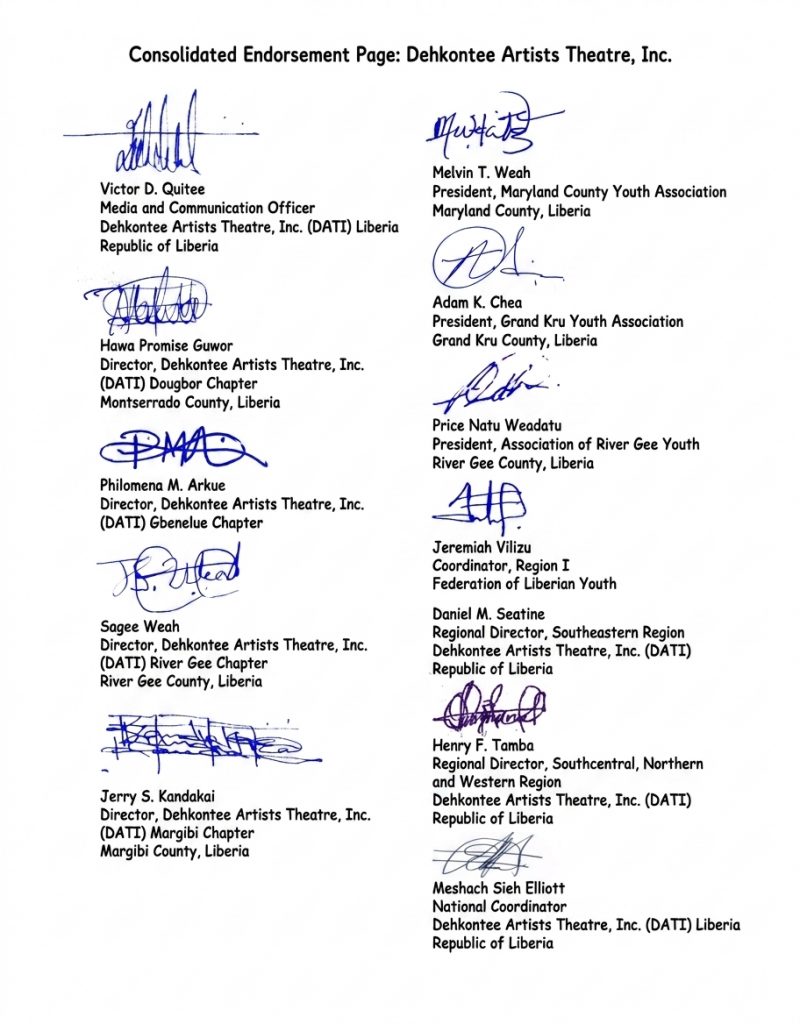
Appreciation Letter
The appreciation letter was signed by representatives of DATI, youth organizations and regional leadership, including Victor D. Quitee, Media and Communication Officer, DATI Liberia; Hawa Promise Guwor, Director, DATI Dougbor Chapter; Philomena M. Arkue, Director, DATI Gbenelue Chapter; Sagee Weah, Director, DATI River Gee Chapter; Jerry S. Kandakai, Director, DATI Margibi Chapter.
Others are: Melvin T. Weah, President, Maryland County Youth Association; Adam K. Chea, President, Grand Kru Youth Association; Price Natu Weadatu, President, Association of River Gee Youth; Jeremiah Vilizu, Coordinator, Region 1, Federation of Liberian Youth; Daniel M. Seatine, Regional Director, Southeastern Region, DATI; Henry F. Tamba, Regional Director, Southcentral, Northern and Western Region, DATI; and Meshach Sieh Elliott, National Coordinator, DATI Liberia.
Youth leaders and DATI members signatures
For his part, Dr. Rabbi Prince Joseph Tomoonh-Garlodeyh Gbaba expressed heartfelt appreciation to progressive youth organizations across Liberia, particularly young people from Maryland, Grand Kru, Margibi, River Gee and Liberia at large as well as various DATI chapters, for what he described as their foresight, courage and commitment to progress and justice and publicly supporting and acknowledging President Boakai for conferring the national honor upon him.
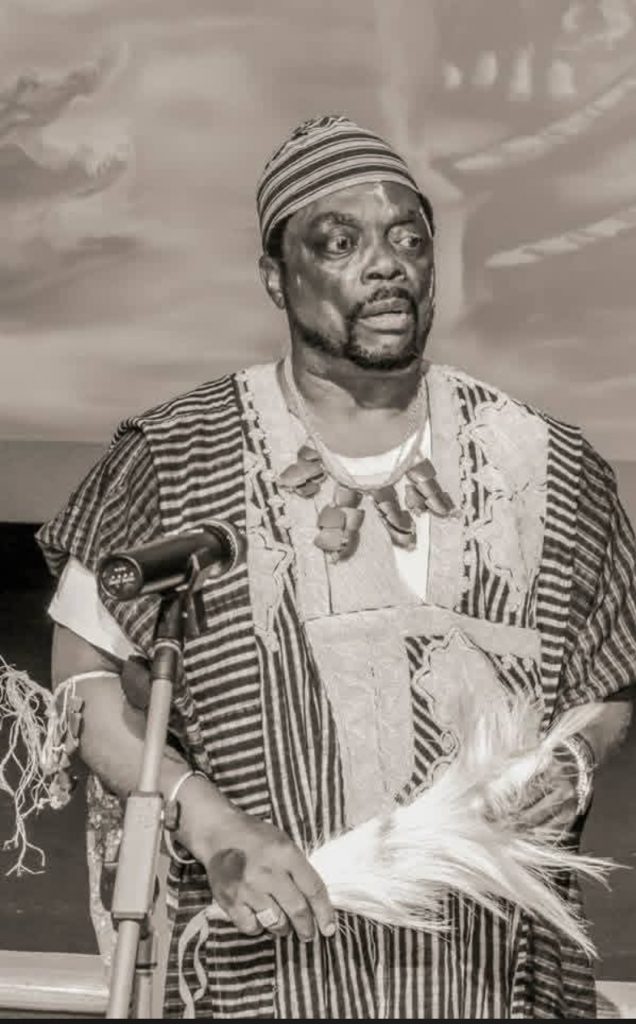
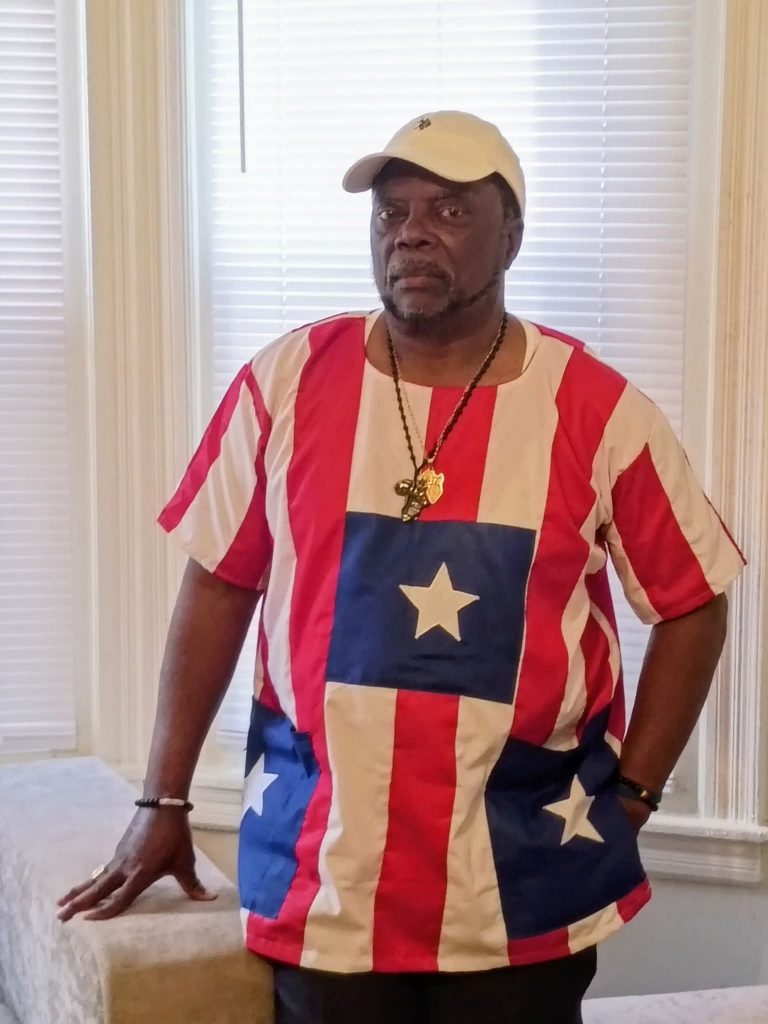
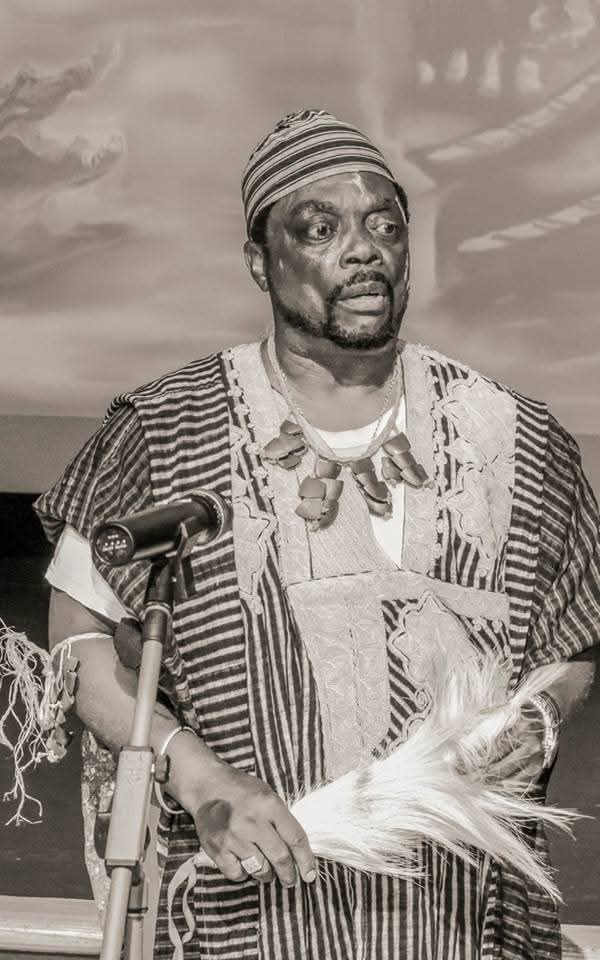
The Rabbi Dr. Joe Gbaba
He said the advocacy of Liberia’s youth helped draw attention to his 52 years of service dedicated to preserving Liberia’s history, culture and shared heritage while promoting peace, national unity and youth development. The Rabbi Gbaba encouraged young Liberians to remain connected to their ancestral heritage and cultural traditions, emphasizing that a strong understanding of Liberia’s identity is essential to building a peaceful and prosperous nation.
He further expressed concern about barriers that prevent meaningful youth-development initiatives from reaching policymakers, particularly proposals designed to create jobs, skills training and peace-building opportunities for Liberian youth thus expressing hope that President Boakai will consider DATI’s proposal to create employment and training opportunities for young Liberians while strengthening the country’s peace-building and reconciliation efforts.
Meanwhile, the youth organizations emphasized that honoring Dr. Gbaba is not only a recognition of his past service, but also a call to invest in Liberia’s young people, culture and future outlining that the recognition should serve as an opportunity for Liberia to place greater emphasis on its cultural heritage, empower young people and build stronger partnerships between government, youth and cultural institutions.
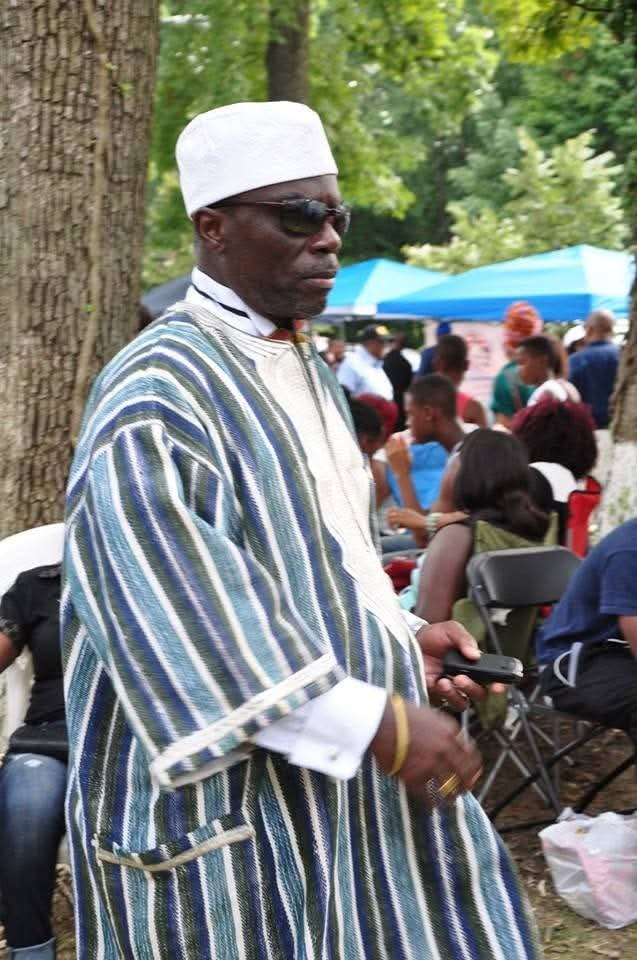
Through it all God has been my strength, my very present help in times of peace and troubles and he made it possible for me to live to see this day when the LAMCO Family Reunion organization is giving me my flowers while I still have breath. It is also a plus to the Boikai administration for the national recognition as well and thanks to the youth of Liberia who have so much trust and faith in me as their father and mentor.
Today, our gathering is about a community that resided in Nimba County and we cannot celebrate LAMCO without celebrating the county and people in whose land we lived, attended school and worked. As for me and my household, we have a unique Nimba story and inheritance that I would like to share with you.
My Nimba Connections and Heritage
My connection with Nimba County is deeply rooted in traditional Liberian history. The people of Nimba and Grand Gedeh Counties have been neighbors and in-laws for centuries, long before the modern Republic of Liberia was established. Through interethnic marriages, we have children born through the unions of Krahn, Mahn, and Dahn parents, such as the Tuazamas, Towehs, etc. And, for the record, my Nimba relatives and friends call me “Saye Tomah Gbaba.”
Here, my name is blended with Mahn, Dahn, and Krahn backgrounds. I am named Saye because I am first born male in my family (even though technically speaking it is a name given to the first born of a woman, not the man). The name “Tomah” I inherited from my father. It was bestowed upon my father at birth more than a century ago by a Dahn chief who was friends with my grandfather named Keh-Gbaba, a descendant of the Nien Dynasty of Krahn kings and descendant of Yarlee-Gbenh, founder of Zwedru City, the capital city of the Krahn ethnic group of Liberia.
According to family history, when my father was born over a century ago, the Dahn chief who lived in Tappita traveled on foot with his entourage for miles, bringing gifts to congratulate my grandfather and to attend the naming ceremony. When the Dahn chief arrived and was warmly welcomed, he told my grandfather, “I name our son Tomah. In our dialect, “Tomah” means “a successor”. When I die, he will take my place.” That’s how my father got his Gio/Dahn name. Over the years, the Krahn people could not pronounce “Tomah” as it is pronounced in the Dahn language. Thus, they ended up mispronouncing Tomah as “Tomoonh”.
Beware of the Falsehoods of Liberian Politicians and Their Divide and Rule Tactics
I know for you young Liberians, you might be wondering, how come a Dahn chief named a Krahn prince with a Dahn name. If the people of Nimba and Grand Gededh are supposed to be “enemies” then how come a Dahn chief traveled hundreds of miles by foot to celebrate the birth of a Krahn prince? If the people of Nimba and Grand Gedeh are archenemies as the Liberian press and politicians portray then why are so many Dahn and Mahn people residing in Grand Gedeh and intermarried even after a so-called bloody civil war that claimed the lives of a quarter million Liberians?
I am sharing this story with you because the story you have been told about the people of Grand Gedeh and Nimba being “enemies” is FALSE. It is a distortion of the truth and it is a “divide and rule” tactic that the True Whig Party government used for more than a century to divide and rule Liberians by putting one ethnic group against the other to maintain power for more than 133 years.
My Childhood Experience as a Resident of Nimba County
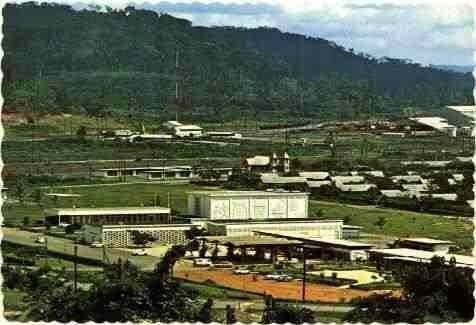
I was five years old when my parents relocated to Gbapa, Nimba County during the diamond rush in the late 50s and early 1960s. Gbapa back in the day was a small diamond mining settlement along the way to Yekepa, Cassava Farm and Camp Four and New Yekepa where I staged my first drama, “Life Story of Kekula” 52 years ago.
My parents were engaged in the diamond mining business. My stepfather (Thomas Sackor) worked at a diamond creek in Gbapa and my mother, Princess Gbeh-Nyennonh-Garh Gaye, ran her “cold bowl” shop.
There were no public schools in Gbapa those days, so my parents sent me to live with a Mandingo friend of theirs and a diamond broker named Lassana Kamara who lived in Sanniquillie to attend St. Mary’s Catholic Mission School. That was how I was privileged to see Presidents William V. S. Tubman, Osage Fu Kwame Nkrumah, and Papa Sekou Toure, when they attended the Sanniquillie Conference in 1959!
My Mandingo adopted father (Lassana Kamara) was married to a Mandingo lady named Ma Fanta and another Fula lady whose name I do not recall. He lived right up the hill opposite the Sanniquillie Market before you descend the hill where the Dunbar Pond is and before you go past St. Mary’s campus. My father Lassana Kamara did not have any child at that time so he took me with him everywhere he went to transact his diamond business. We traveled to Bahn and Seclepea and other regions of Nimba that I cannot recall. I even learned how to speak Mandingo at one point in time and I enjoyed the morning breakfast called “monnee”. It is a kind of cereal meal—very nice!
After several years in Gbapa, my parents moved back to Monrovia when I turned nine. The second time around when I returned to Nimba, I was enrolled at Archbishop Carroll High School as a sophomore student in 1972. For three years, I studied under the rigid and disciplinary guidance of English and Irish Christian Brothers, studied Shakespeare, Wordsworth, Rousseau, Emerson, you name it. Suddenly, in my senior year something happened that changed my life forever. I had a vision in which the Lord inspired me to write the “Life Story of Kekula” which today turned out to be a story about myself. What an irony.
“Life Story of Kekula” Starring Bill Ross, III and Rosaline Rogers
As you are aware, Archbishop Carroll High School those days was an all-boys school and so you might wonder how I recruited girls to participate and where did the rehearsals take place. As a young man, I carried myself responsibly. I founded a Christian organization on campus called Creating Friendship in Christ (CFC). I was the Right Hand Brother and Robert Freeman, Jr. was Left Hand Brother and Bill Ross, Henrique Zobon Scott, Harrison Yaidoo, Harry Tucker were Honorable Brothers.
We approached the parents and assured them that their daughters would be safe when they came on Carroll High Campus in Grassfield and I made sure those hot Carroll High Cobras did not mess around my girls. Mr. Sirleaf, a famous, loving, kind bus driver brought the girls on campus for rehearsals and took them back home safely.
On the day when we performed “Life Story of Kekula” in October 1974, the Open Door Theatre was full to capacity! Among some of the prominent LAMCO personalities who attended the debut performance of “Libe Story of Kekula were Honorable Charles B. Roberts, Administrative Manager, Honorable John G. Rancy, Superintendent of Schools, Dr. Varsay Sirleaf, Magistrate James Harris, Sr., and my surrogate mother, Mrs. Dolly McCritty Massaquoi.
Members of the cast included Robert Freeman, Jr., Caleb Domah, Henrique Scott, Winston Conteh, Joseph Zig Collins, Jr., Stephen Daniels, Jr., the Cole Sisters, Roseline Rogers, Geleh Massaquoi, Bill Ross, III, Kerper Dwanyen, Leon Padmore, Patrick Forforh, Edsel Deshields, Joseph E. Deshields, Charles Samuels, Africanus Richardson, Patrick Ajavon, Harrison Yaidoo, Harry Nagbe Tucker, Jarloth Wolo, Jr., Allen Cassell, Samuel Brownell, Jr., etc. There were members of the international community in the house as well.
Interestingly, the elders who watched the show could not believe what they saw. Honorable Charles B. Roberts laughed his heart out in the balcony and when the show was over, he came down to congratulate me. He gave me my first pay check as a playwright, Five Hundred Untied States Dollars! Mommy Dolly wrote me a note congratulating me and foreseeing my becoming “Liberia’s Shakespeare”, and Magistrate Harris, blessed me and urged me to “keep up the good work.”
“Life Story of Kekula” was a documentary about national integration and unity, but it was a comedy and through the comic scenes I presented a narrative about creating national unity through interethnic marriage.
Today, I am a living witness to what I preached 52 years ago. Princess Ariminta, my wife, is a member of the Porte Family from Crozierville and I am a descendant of Krahn kings from Grand Gedeh County. My wife is the new “Sussie” and I am new “Kekula” and our intermarriage is blessed with five children and fifteen grandchildren, some of whom are present today.
Our children and all Liberians born of interethnic marriages and their offspring constitute what I would term the “core lineage” of the new Liberian society. 52 years ago, our society was segregated on tribal lines or class system but today we are a more blended and integrated society.
A Big ‘Thank You’ to My Nimba Parents, Guardians and Friends
My success in Nimba County was not attributed to only my schoolmates, professors, and my parents. There were many families that opened the doors of their homes to me as a student whose parents were from Grand Gedeh. My Mandingo father Lassana Kamara, Ma Fanta, Mommy Dolly McCritty Massaquoi, my other parents included Mr. and Mrs. Stephen Daniels, Sr., Mr. and Mrs. Joseph Zig Collins, Sr., Mr. and Mrs. Cassell, Mr. and Mrs. David Dwanyen, Mr. and Mrs. Gabriel Farngalo, my friends Deborah Cranshaw, Ophelia Dolo, Margaret Dookie, and my brothers James Zota (aka Dennis), Patrick Suah, Patrick Forforh, Caleb Domah, George Farngalo, George Dahn, Nathaniel Biah, George Jacobs, Prince Tebbs, and LAMCO Family Union Organization.
What a blessing to be in your midst!
I love you.
Rabbi Prince “Saye Tomah” Gbaba, Sr., Ed. D. August 8, 2026